


Language services.
Our offerings turn a multilingual operation into something owned and audit-ready. Plus a series of specialised dictionaries, for those still in love with paper.
Machine Translation Post-Editing
For organisation running machine translation in production who need an audit trail.
We post-edit machine output to a published quality level (light or full), with subject specialists in the seat: pharmacologist-translators on pharmaceutical content, lawyer-translators on contracts, engineer-linguists on technical documentation.
Per client and per content type, Expert-at-the-Core specifies where machine translation is deployed, where LLM-assisted revision is acceptable, where post-editing levels sit, where human-only workflows are required, and what audit trail is preserved. The output is defensible translation a risk committee can sign off. Not cheaper translation, delivered faster.
DTP and document reconstruction
For organisations with PDFs, scans or photographs that need translating and rebuilding.
The finished document matches the original page for page: fonts, layout and formatting. Multilingual material at varied complexity: non-Latin character sets, language-specific hyphenation, country-specific formatting. We extract assets where the source contains logos, seals, stamps, signatures or barcodes that need to be preserved or replaced cleanly.
What is DTP, and when do I need it?
Desktop publishing is the typesetting and layout work that brings a translated text back to a finished document: InDesign artwork, structured Word and PowerPoint files, PDFs ready for press or screen. You need it whenever your source was laid out for distribution and the translation is expected to look the part. Where the budget allows, tidy the layout before translation: a clean, well-structured source produces better matches and a faster pass afterwards. Where the source is fixed, we work back from it.
What files should I send?
For InDesign work, the full package: the .indd file, the matching .idml, the linked images and fonts folders, and a PDF of the source for reference. For Word, PowerPoint or PDF, the editable file and any instructions from your client. Where a scan or photograph is all there is, send the highest resolution you have: the rebuild is only as good as the image.
What do you need from me to quote accurately?
The complete source files, the source and target languages, your instructions on tone and terminology, and your client’s specifications: house style, fonts, print or screen, accessibility requirements, key dates. Anything missing we ask for; a clear brief is the best predictor of a clean delivery.
Can you translate text inside images?
Yes. Mark the text in the image with annotations in Word, PowerPoint or Google Drawings and we translate it and put it back, in as many languages as you need. If you extract the text yourself as plain text, we translate it and place it back, although embedded formatting such as headers, footers and special paragraph styles will not survive the round trip. Without the original linked images we can deliver low-resolution PDFs only; print versions need the linked artwork.
Will my font work in every language?
Western European languages in Latin script (Italian, French, German, Spanish and others) keep the source font. Cyrillic (Russian, Ukrainian, Serbian, Bulgarian), extended Latin (Czech, Polish, Hungarian), Chinese, Japanese and Korean, and right-to-left scripts (Arabic, Farsi) need a compatible substitute. We propose one for each language and ask you to confirm it before we start; your own choice is welcome where you hold the licence. The decision is taken by a typesetter who reads the language, not by a global font swap.
Do you produce print-ready PDFs?
Yes, to your printer’s specification: bleed, crop marks, colour profile and PDF export settings. Without one we deliver standard high-resolution PDFs, which suit screen and office printing. Tell us at the briefing which you need.
Can you turn a PDF back into an editable Word file?
Yes. We reproduce the layout as closely as the original allows, apply paragraph styles and rebuild automatic tables of contents where the source had them. Before we start, tell us the languages, whether text in images should be editable, whether handwriting should be transcribed, whether headers, footers and the contents table should update automatically, and whether stamps, signatures and seals should be inserted as images. Each choice changes what comes back, so settling them early saves rework.
Linguistic Quality Assurance
For organisation running translation in-house, taking work from another supplier that needs a second opinion, or preparing documents for regulatory submission.
Independent review against the source, against your terminology, and against the published industry standards for translation quality (MQM, DQF). Bilingual or target-only at your discretion. The language risk is the part nobody else is looking at.
Terminology Management
For organisation whose terminology is scattered across vendors, business units or languages, and who’d rather own it.
Termbase architecture, migration, curation and longitudinal governance, offered as a standalone advisory and operational engagement.
Terminology is a corporate asset, not a project by-product. Left in a supplier’s system, it is only as good as that relationship; owned by you, it compounds across every supplier you use. The deliverable is portable, exportable, owned by you.
Language-technology and AI-governance consultancy
For multilingual operations that have grown incrementally and now need a deliberate footing.
We operate as a LangOps consultancy: the operational discipline that runs language work like a regulated system.
- Vendor rationalisation
- Workflow design
- AI-governance frameworks documenting where you deploy machine translation, where LLM-assisted revision is acceptable, where post-editing levels sit, where human-only workflows are required, and what audit trail is preserved
- Support in TMS selection and implementation
Language assets
For translation companies, in-house language teams and multinationals that want their language infrastructure built or rebuilt to last.
Translation memories that compound across projects rather than rotting between them. Termbases that reflect your actual vocabulary across business units and languages. Style and editing manuals that make a unified voice possible across vendors. DTP guides that turn document reconstruction into a repeatable process. Bespoke electronic dictionaries for technical, scientific and legal domains, in collaboration with our language services studio, Rhyme&Reason.
The deliverables are portable, exportable, and yours.
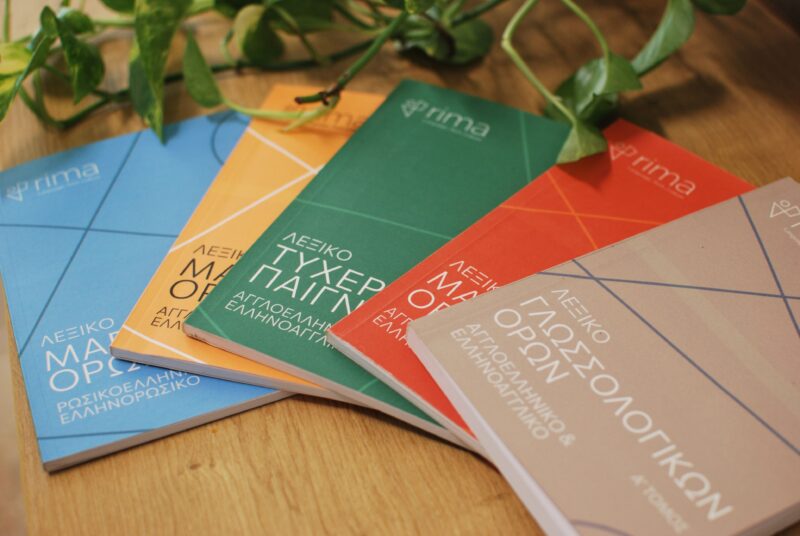
Lexicography series
RIMA-branded paper specialised bilingual dictionaries.
- Dictionary of Culinary Terms, English↔Greek
- Dictionary of Gambling Terms, English↔Greek
- Dictionary of Mathematical Terms, English↔Greek
- Dictionary of Culinary Terms, Russian↔Greek
- Dictionary of Linguistic Terms, English↔Greek (Volume I)
